




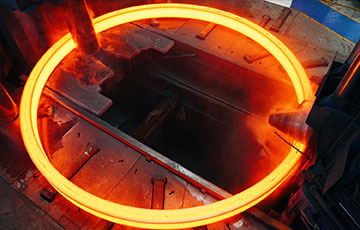
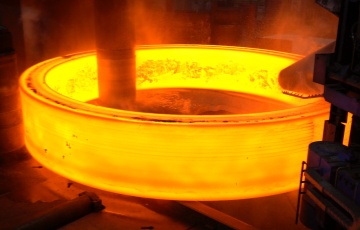
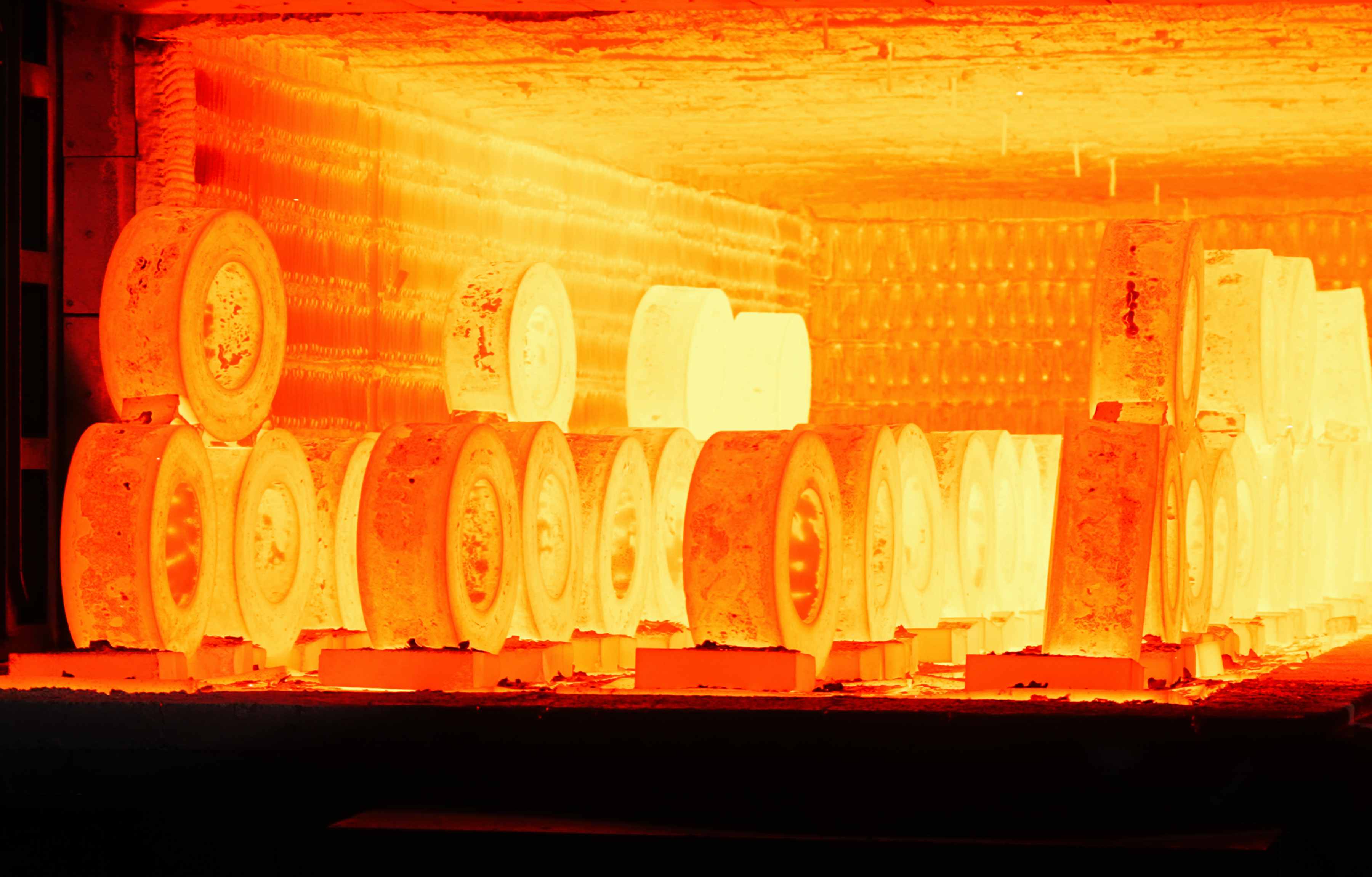
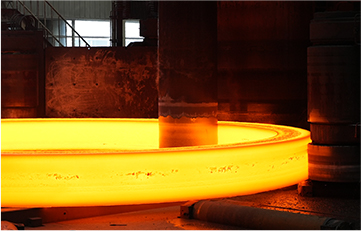







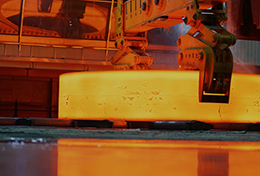


Heavy-Section Seamless Rolled Ring for Tunnel Boring Machines: Controlling Property Variation
A heavy-section seamless rolled ring for tunnel boring machines needs consistent material properties as well as the correct dimensions. In a TBM main bearing, axial thrust, radial loads and tilting moments act together while the cutterhead rotates. Uneven properties within a bearing ring can create local weaknesses in a component that must carry changing loads throughout excavation.
The manufacturing challenge is therefore one of consistency: how to form and heat-treat a large ring to limit unwanted variation in mechanical properties around its circumference. A TBM bearing-ring project supplied by Iraeta illustrates how rolling deformation, quenching-water control and thermal-process design address that challenge together.

1.The Main Bearing Makes Uniformity a Functional Requirement
The main bearing connects the rotating cutterhead with the machine structure and transfers the forces generated during tunnelling. It must accommodate axial thrust as the machine advances, radial loads associated with earth pressure and machine weight, and tilting moments caused by unbalanced forces.
These loading conditions make the bearing ring more than a circular structural element. As the cutterhead rotates, the loads change cyclically. Different regions of the ring must respond consistently rather than behave as isolated sections with substantially different properties.
Uneven mechanical properties can contribute to uneven stress distribution and local stress concentration. In the bearing system, the resulting damage may include cracking, deformation, premature wear or spalling. Uniformity therefore belongs in the discussion of component performance, not only in the final inspection report.
The underground operating environment makes that distinction important. Once the machine is excavating, access to the main bearing is difficult. A serious bearing problem can interrupt tunnelling and require extensive intervention. Manufacturing consistency must be established before the component becomes part of a system that is difficult to repair.
For custom bearing ring forgings, the relevant requirement is consequently not just “large enough for the bearing.” It is a ring whose material condition is suitable for the repeated and combined loading of the application.
2.An 18-Metre TBM Project Put the Challenge into Focus
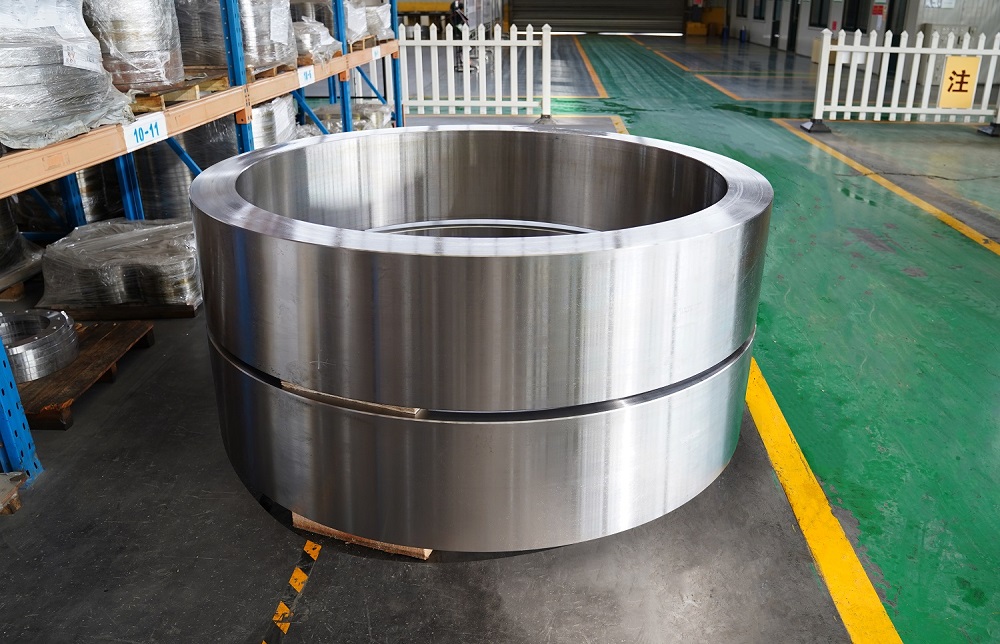
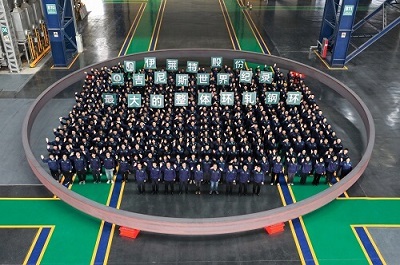
In 2023, a major Chinese TBM manufacturer planned a machine with an 18-metre cutting diameter. The main bearing assembly weighed more than 60 tonnes. The bearing rings required a manufacturing approach capable of delivering the necessary mechanical properties with a high degree of uniformity.
The project scale is significant, but the figures describe different parts of the machine. The 18-metre dimension refers to the cutting diameter; the weight refers to the main bearing assembly. Iraeta’s contribution was the manufacture of critical bearing rings rather than the complete bearing.
The TBM bearing-ring project brought three manufacturing issues into the same process plan:
Achieving substantial deformation during ring rolling.
Maintaining controlled cooling conditions during water quenching.
Developing a heat-treatment profile appropriate to the large component.
The reported outcome was hardness variation controlled within 20 HB. Understanding that result requires looking at how the manufacturing measures worked together rather than treating it as a standalone quality figure.
3.First, the Ring Had to Be Adequately Worked
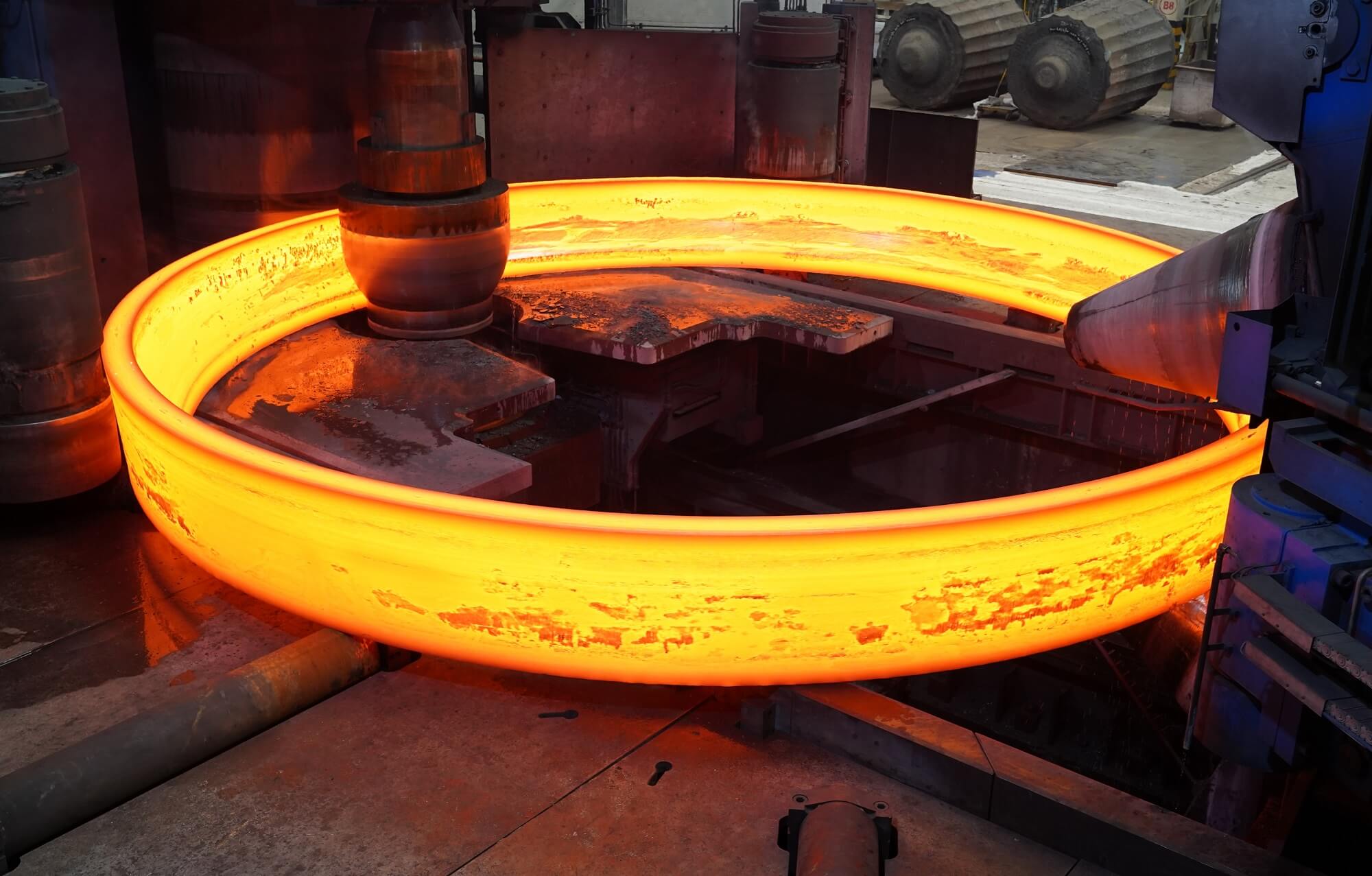
Large ring dimensions require suitable forming equipment, but accommodating the workpiece is only the beginning. The rolling operation must also apply the deformation needed for the forging.
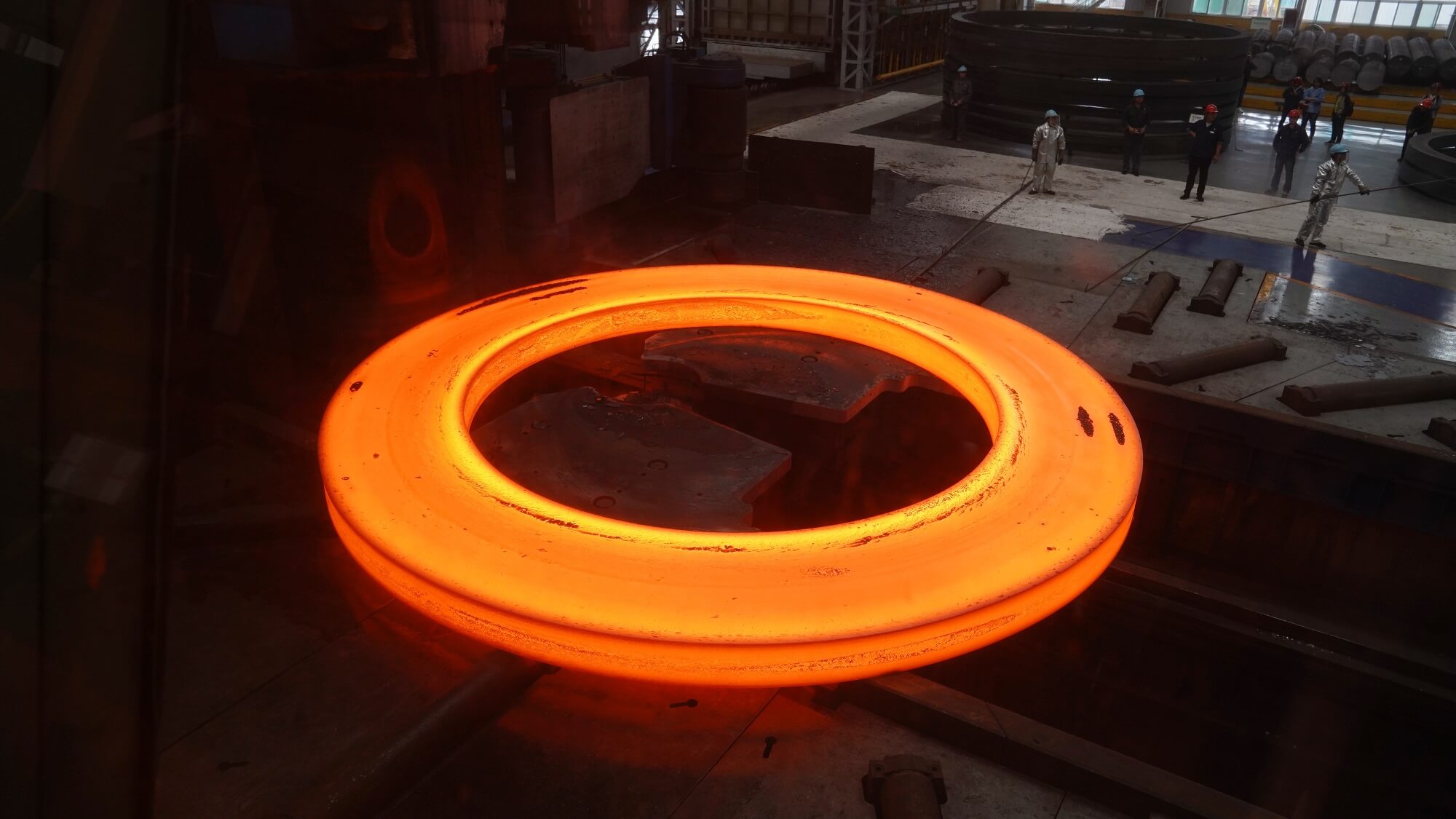
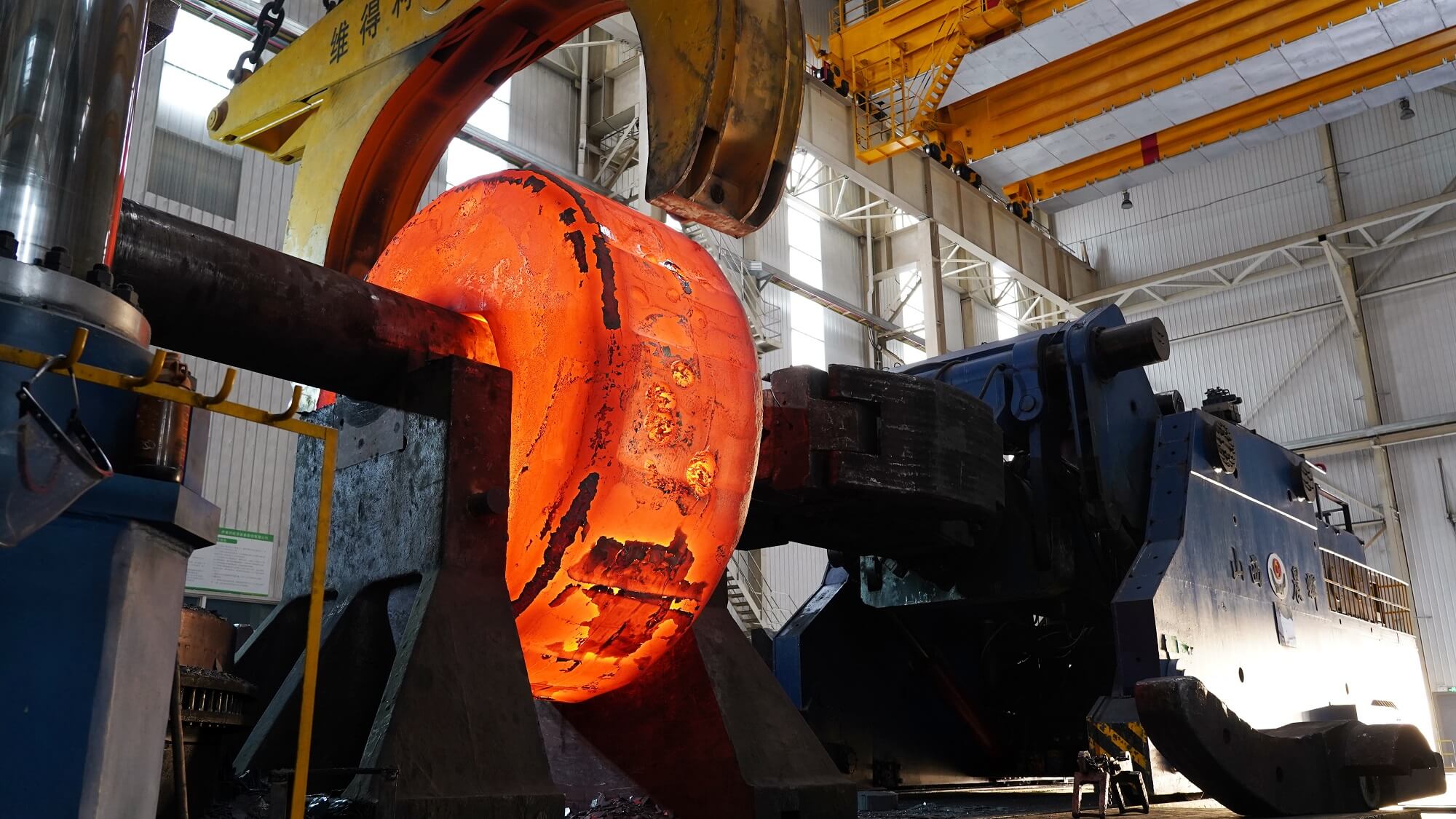
For this project, a 16-metre SMS ring rolling machine supplied high rolling force to achieve substantial deformation. The route also reduced repeated heating and supported dimensional control.
The distinction between machine size and deformation capability matters. A mill’s dimensional envelope indicates the scale of work it can accommodate. The forming task concerns what happens to the material as the ring develops toward its required geometry.
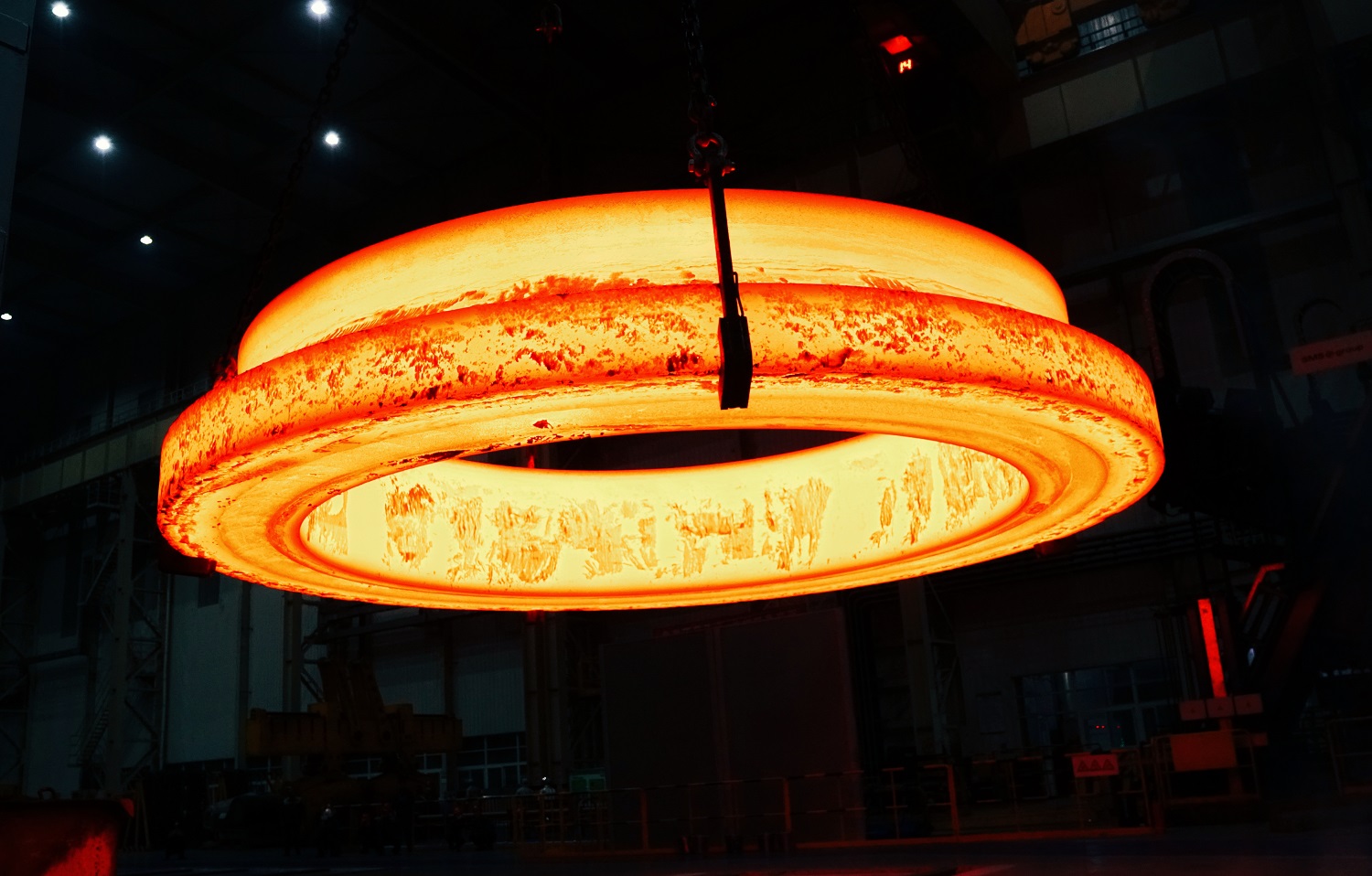
In a heavy-section bearing ring, that task cannot be assessed through outside diameter alone. The radial section, axial height and material requirements belong in the same manufacturing discussion. Together, they describe the component that must be worked and subsequently heat-treated.
Ring rolling establishes the condition entering the next stage. Heat treatment then develops the required balance of properties in the formed component. Neither operation should be considered independently: a thermal process is applied to a ring with a particular geometry and manufacturing history, not to an abstract material grade.
This is where the broader ring rolling and heat treatment capabilities become relevant. Their value lies in how they are selected and coordinated for the bearing ring rather than simply in the number of available processes.
4.Then, Cooling Had to Remain Controlled
Large bearing rings make heat treatment more demanding because different regions of the component can respond differently during cooling. Achieving the intended material condition consistently becomes harder as the size of the part increases.
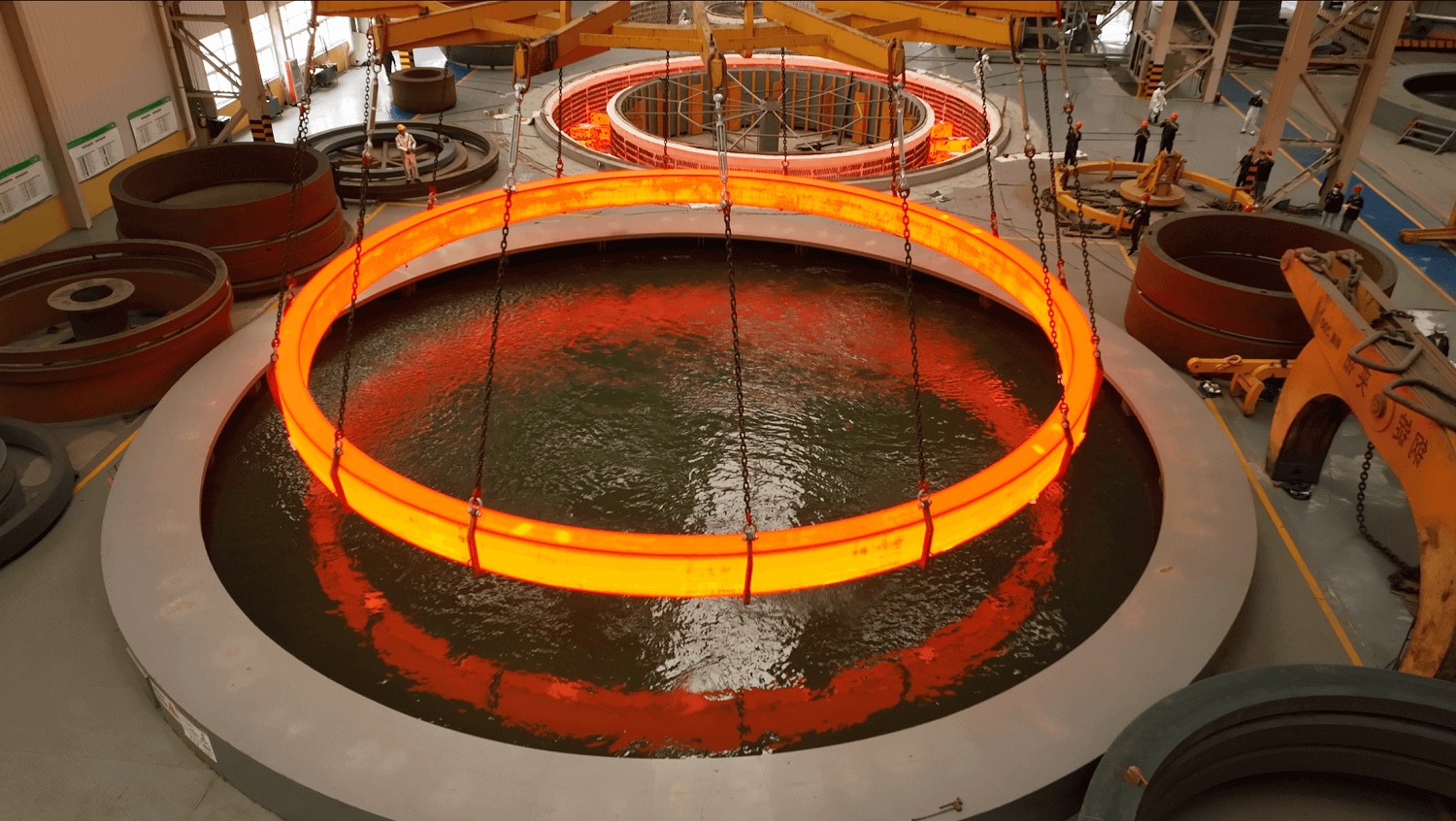
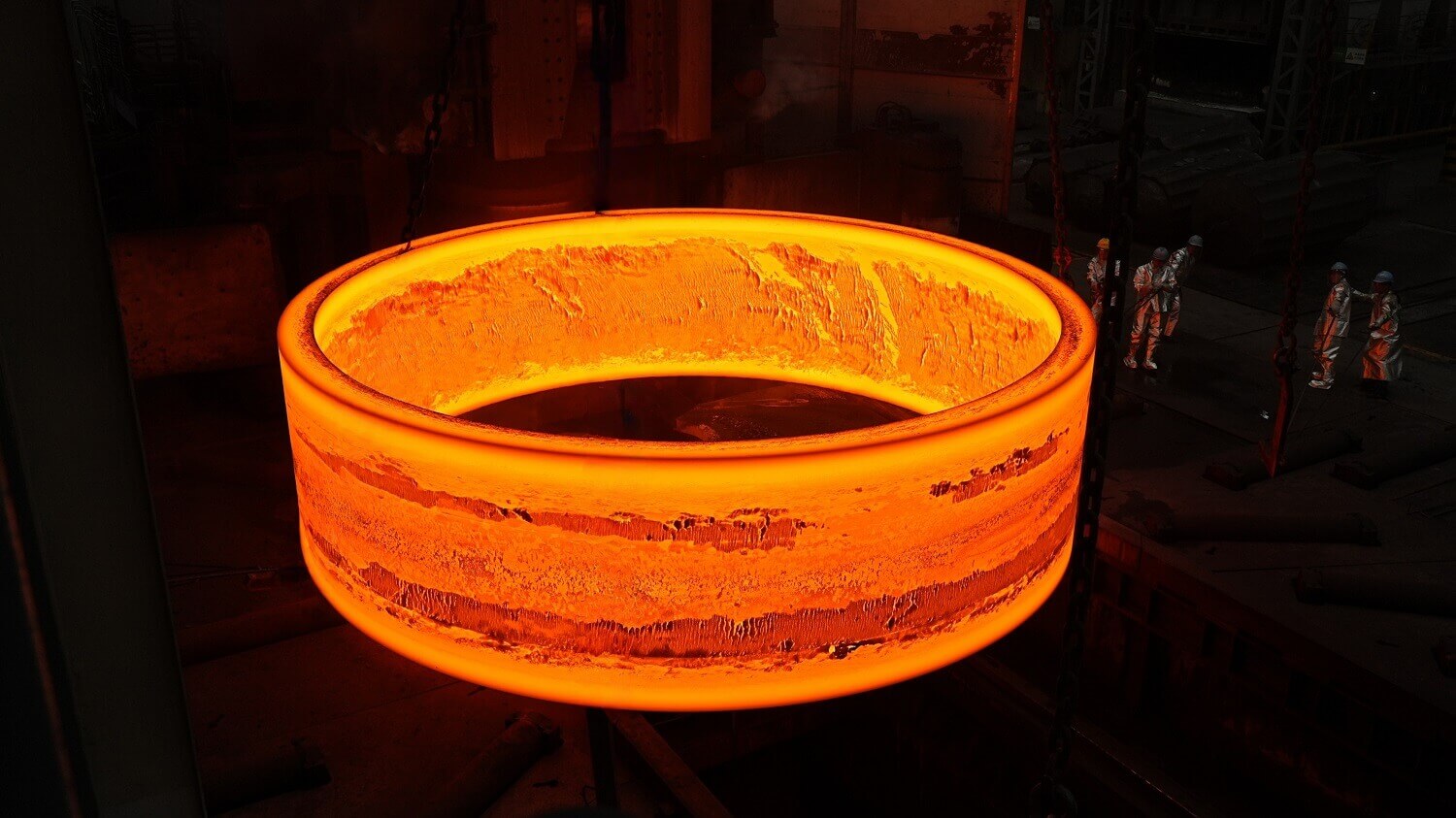
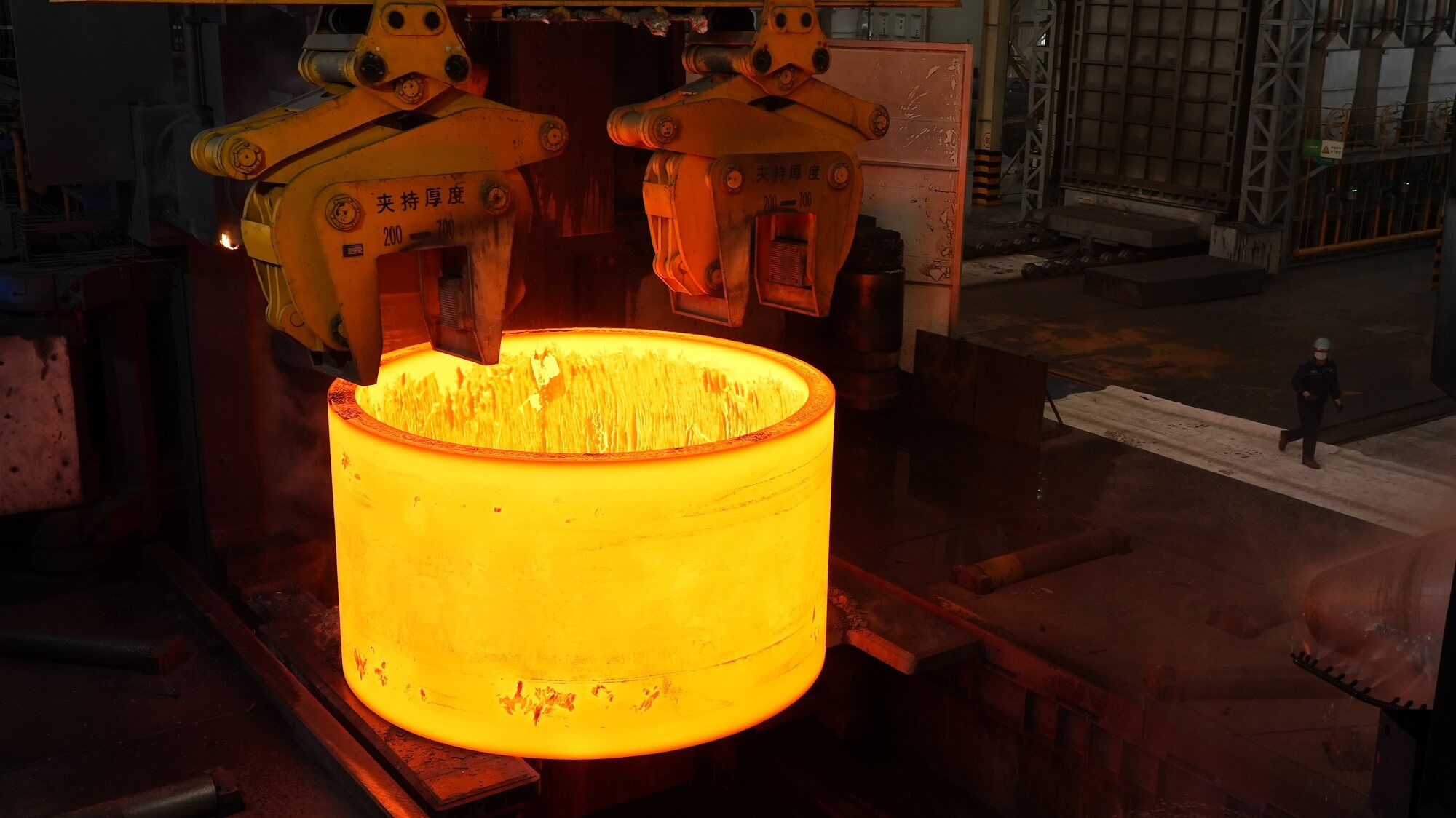
For the TBM project, the water-quenching arrangement included a spray agitation rate of up to 7,200 m³/hour and water circulation exceeding 2,800 m³/hour. A dedicated cooling system prevented the quenching medium from overheating during treatment.
These figures describe different functions within the system. Agitation, circulation and control of the water temperature contribute to the cooling operation, but they are not interchangeable measures.
The distinction is useful when evaluating a heavy-section seamless rolled ring for tunnel boring machines. A high water-flow figure alone does not explain the resulting material properties. The question is how the quenching arrangement maintains the intended cooling conditions while processing the actual ring.
The dedicated cooling system is part of that answer. Controlling the medium throughout treatment helps maintain the intended quenching conditions rather than relying only on the water’s initial condition. In this project, water management was an active manufacturing control, not a supporting utility mentioned separately from heat treatment.
The ring section and the cooling system therefore need to be considered together. Geometry defines the component being treated; the quenching arrangement provides the means to carry out the selected cooling process.
5.Thermal-Process Design Connected the Equipment to the Ring
The rolling mill and quenching system established the available manufacturing capability. The heat-treatment profile determined how that capability would be applied.
Engineers used simulation software together with historical production data to develop the temperature profiles for the bearing-ring project. The engineers involved each had more than 15 years of heat-treatment experience.
This combination is important because a large ring cannot be treated simply as a larger version of a familiar small component. Its geometry and processing requirements must be addressed in the thermal plan.
Simulation supported the development of that plan, while historical data connected the proposed treatment with previous manufacturing experience. Engineering judgement brought those inputs together for the component being produced.
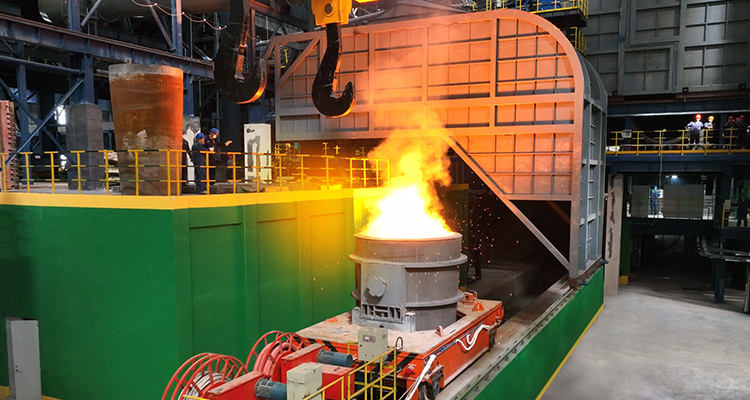
The process illustrates a practical relationship between expertise and equipment. A powerful rolling mill does not specify the thermal profile. A quenching system does not decide the required material condition. Those decisions must be made around the ring’s requirements and then implemented through the available equipment.
For a buyer or bearing designer, that is a more informative discussion than a list of furnace capacities. It reveals how the manufacturer approaches the component, not merely which assets are installed in the workshop.
6.What the Hardness Result Actually Shows
The project reported hardness variation within 20 HB. This is a uniformity result: it describes a difference in hardness, not an absolute hardness target for the bearing ring.
That distinction changes how the figure should be interpreted. A statement that a component reaches a specified hardness level addresses one question. The reported hardness variation provides an indication of consistency at the assessed locations.
In the TBM application, consistency is relevant because the ring carries changing loads around its circumference. A uniformity requirement helps connect the heat-treatment outcome with that operating task.
The result also gives the manufacturing account a measurable endpoint. The project did not stop at describing a large mill, high water throughput or simulation work. It linked those measures to a reported property-control outcome.
Hardness variation remains one part of the bearing-ring requirement. Its significance depends on the specified inspection scope and assessment locations. It does not, by itself, establish uniformity of every mechanical property throughout the entire ring section.
For another ring, the useful starting point is therefore not to copy the 20 HB figure automatically. It is to establish the required properties and determine how the selected manufacturing route will produce and verify them.
7.Applying the Experience to Another Heavy-Section Ring
The project offers a way to examine manufacturing suitability without assuming that every TBM ring needs an identical process.
The first consideration is the actual section. Outside diameter indicates overall scale, but wall thickness, axial height and profile define more of the component that must be formed and cooled. “Heavy-section” is a useful description, not a complete engineering specification.
The second consideration is the relationship between forming and thermal processing. The manufacturing plan needs to explain both how the ring will be worked and how the required properties will be developed afterward.
The third is the evidence used to assess consistency. An equipment specification describes available capability. A thermal plan describes how it will be used. Inspection results show whether the processed component meets the agreed requirements. These serve different purposes and are most useful when reviewed together.
This keeps the discussion centred on the bearing ring’s function. It also avoids reducing supplier assessment to maximum diameter, installed machine size or a single successful hardness result.
8.A Bearing Ring Must Perform as One Component
The central lesson from the TBM project is that property consistency is created through coordinated manufacturing decisions. Substantial rolling deformation, controlled water quenching and an engineered thermal profile addressed different parts of the same problem: producing a large ring with the material properties required for its bearing application.
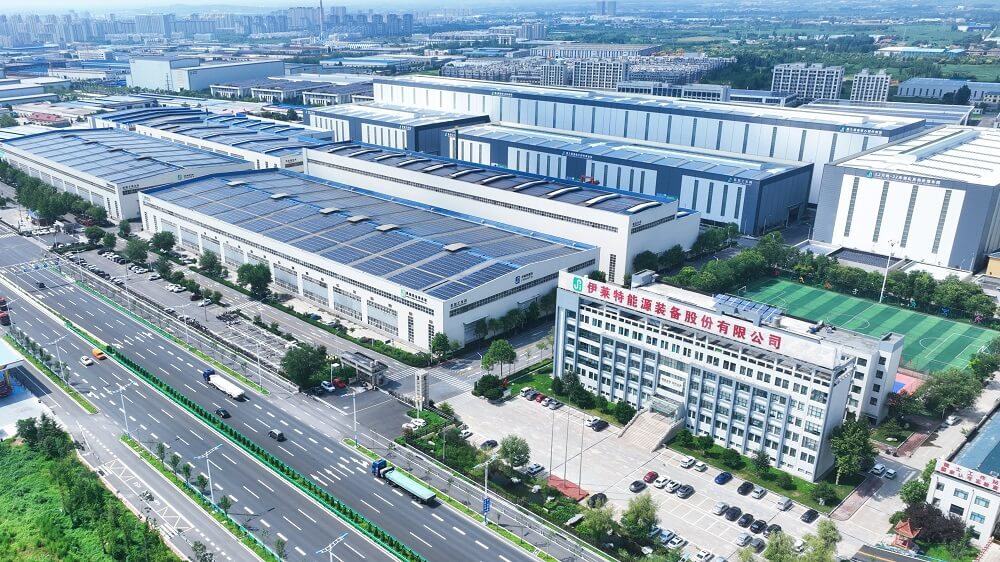
For a new heavy-section TBM bearing ring, the technical discussion should begin with the required performance across the component—not with a catalogue of equipment. Iraeta’s experience provides a basis to discuss property-uniformity and heat-treatment requirements, connecting the bearing designer’s expectations with the manufacturing controls needed to achieve them.


Recommended reading
Unlocking the Secrets of Forging: The Performance Code of Classic Processes
Must-Read for Ring Forging: Advantages and Applications of the Forge-Rolling Process
Open-Die Forging vs. Ring Rolling: Helping You Choose the Optimal Forging Process